







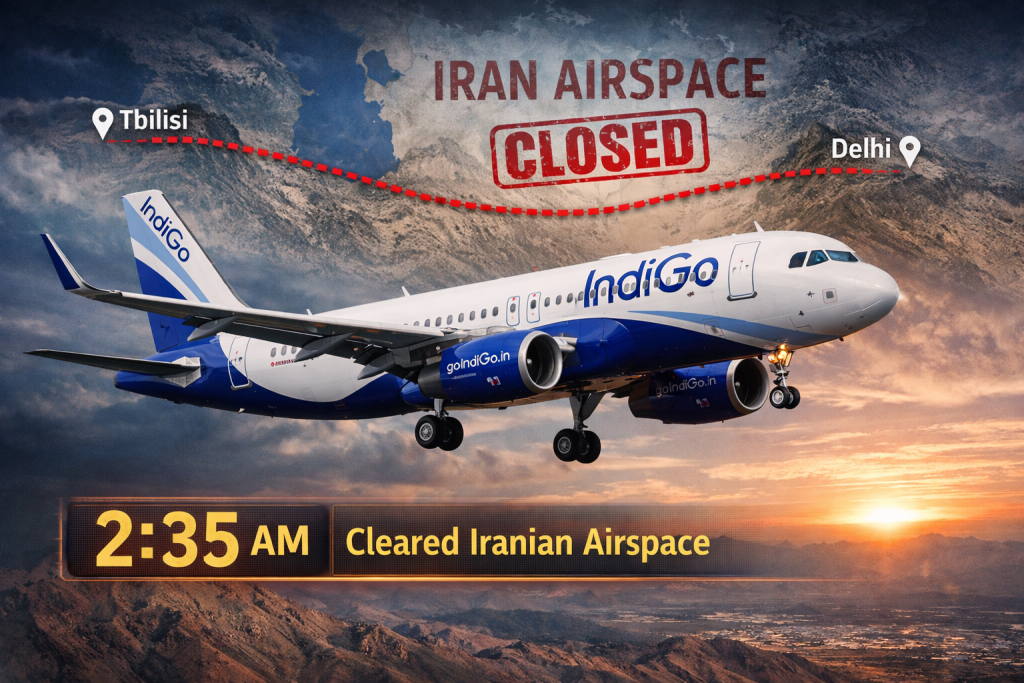
In a dramatic moment for international aviation, an IndiGo flight bound for Delhi narrowly exited Iranian airspace just minutes before Tehran abruptly closed its skies, triggering widespread disruptions across global flight operations. The Close Call: Flight 6E1808 On the night of January 14–15, 2026, IndiGo flight 6E1808, flying from Tbilisi in Georgia to Delhi, passed over Iran at approximately 2:35 am IST — a mere 20–25 minutes before Iranian authorities shut their airspace amid spiralling unrest and rising geopolitical tensions.
Flight-tracking data shows the aircraft was one of the last non-Iranian commercial planes in the sky above Iran before authorities issued a sudden Notice to Airmen (NOTAM), halting most flight operations in Iranian airspace. The plane landed safely in Delhi at 7:03 am, completely unaware just how narrowly it had avoided being caught in one of the most disruptive aviation incidents in recent times.
Why Iran Closed Its Airspace
Iran’s abrupt airspace closure lasted more than four hours, according to aviation guidance issued by Tehran. Although the Iranian government gave no official explanation, the timing came as the country was engulfed in widespread anti-government protests against Supreme Leader Ayatollah Ali Khamenei and escalating tensions with the United States The move was likely a precautionary measure amid concerns about potential military actions or threats, echoing previous airspace closures Iran has imposed during conflicts such as the Israel-Hamas war and other regional tensions.
Global Aviation Impact
Iran sits on one of the most critical east-west flight corridors connecting Europe, Central Asia, and South/South-East Asia. This makes its airspace crucial for many international airlines. When Tehran suddenly halted most flights: Airlines were forced to reroute or delay flights, sometimes adding hours to schedules. Indian carriers including IndiGo, Air India, and SpiceJet issued advisories about disruptions.
Several long-haul services — including Air India flights to the US — were cancelled or diverted since alternative fuel stops and longer routes weren’t feasible International carriers such as Lufthansa and others also began avoiding Iranian and Iraqi airspace, even after reopening, preferring longer but safer routes through Afghanistan, Central Asia, or around the region.
DIGI MERCH STORE PRINT ON DEMAND

Airlines’ and Passenger Advisory
IndiGo acknowledged that some international flights were impacted, offering rebooking or refunds where appropriate Air India warned that aircraft rerouted to avoid Iranian airspace could face delays and encouraged travellers to check flight statuses before departure. SpiceJet and other carriers similarly issued advisories about potential disruptions. For affected travellers, keeping tabs on airline notifications and being prepared for changes is now a necessary part of flying through the region.
What This Means for You
Even though the airspace was reopened after several hours, the episode highlights several key aviation trends: Geopolitical instability can instantly impact civilian flights over conflict-adjacent airspace. Airlines may continue to avoid certain regions as a long-term safety strategy. Flight planning and rerouting costs are likely to rise for carriers relying on these corridors — potentially passing on higher fares or more complex connections to passengers.
In an interconnected world, where a single airspace closure can ripple across continents, the narrow escape of IndiGo’s Delhi-bound flight is a reminder of how closely aviation intersects with politics, security, and global events. As passengers, being informed and flexible — and airlines staying adaptable will remain critical as uncertainty in key regions persists.
Civilaviationsafety productcatlog
Iranairspaceclosure WearableTech
IndiGobreakingnews Twitterposts
IndiGointernationalflight SmartHome
Comment