







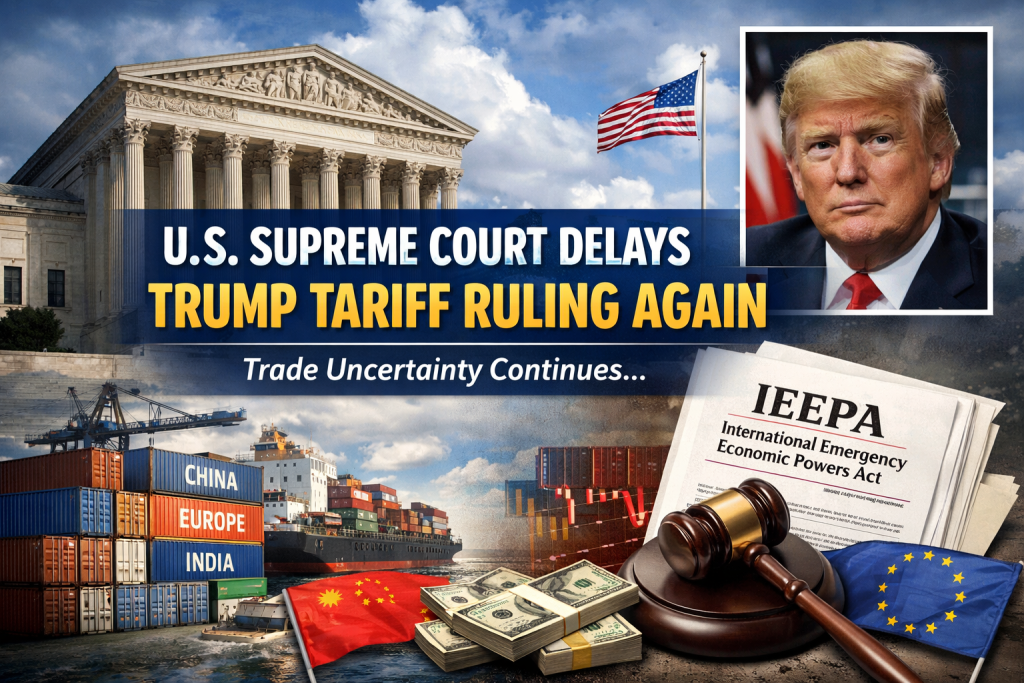
The U.S. Supreme Court has once again postponed its much-anticipated decision on the legality of President Donald Trump’s sweeping tariff regime, leaving governments, companies and markets around the world in a state of uncertainty. This marks the second time the court has skipped delivering a verdict, even though the case was expected to be resolved in early January.
A Case With Worldwide Impact
At the heart of this legal battle is a bold trade policy rolled out by the Trump administration under the International Emergency Economic Powers Act (IEEPA) — a law originally designed to give presidents authority in national emergencies. Using IEEPA, Trump established a broad tariff regime in 2025 with baseline duties of around 10 % on most imported goods and higher rates of up to 50 % on products from certain countries deemed non-reciprocal.
The tariffs quickly rattled global trade dynamics, hitting major economies and export-oriented industries across Asia, Europe, and beyond. India also faced steep levies, including a 25 % general tariff and an additional 25 % duty linked to its energy ties with Russia. Critics — including business groups and a coalition of U.S. states — sued, arguing that only Congress has the constitutional power to impose taxes and tariffs. Lower courts have sided against the administration, and the case ultimately made its way to the Supreme Court, where oral arguments were heard late last year
What Happened on Opinion Day?
On January 14, 2026, the justices issued several rulings in other high-profile cases — but again declined to announce a decision on the tariff dispute. The court gave no indication of when its opinion might be released, or whether it will be among decisions in the coming weeks. This deja-vu moment follows an earlier missed opportunity in the first week of January, when the court also passed without issuing a tariff ruling. Customarily, the Supreme Court does not tell the public in advance which cases will be decided on a given day, so business and government observers are left guessing
Why the Delay Matters so Much
Presidential Power on the Line At its core, this case is not just about trade policy — it’s a constitutional showdown over executive authority. If the court ultimately upholds the tariffs, it could set a precedent granting future presidents broad latitude to impose economic measures under emergency powers, circumventing Congress But if the court strikes down the tariff regime, it would reaffirm congressional control over taxation and trade tools — a powerful rebuke of the administration’s expansive interpretation of IEEPA
Uncertainty for Markets and Businesses
The continued delay has kept global markets and industry leaders on edge. Investors had hoped for clarity that might calm volatility, but instead remain in limbo. Some analysts have warned that a ruling against the tariffs could force the Treasury to refund tens of billions of dollars to importers At the same time, if tariffs stand, companies that rely on imported inputs or export to the U.S. must continue absorbing higher costs, which could shift supply chain decisions and pricing strategies for months or years to come.
DIGI MERCH STORE PRINT ON DEMAND

Political and Public Reactions
Former President Trump has fiercely defended his tariff policy, framing it as a tool for correcting unfair trade practices and boosting U.S. strength. He has also warned that overturning the tariffs would create a complete mess for the economy, especially regarding refunds and market disruptions Treasury officials, however, have tried to downplay some of the worst-case scenarios, suggesting that even if tariffs are struck down, the government can manage refunds and alternative revenue sources
With no date announced for a future ruling, all eyes are now on the Supreme Court’s calendar. The justices could choose to release opinions on a future “opinion day” — which typically occur weekly when the court is in session — or tie resolution of the tariff case to the end of the court’s term later this year Until then, uncertainty remains the dominant theme — for legal scholars, global trade partners, U.S. industry stakeholders and everyday consumers who feel the ripple effects of tariffs through prices and market shifts.
USimporttariffs dailyprompt-2110
Trumptariffcase dailyprompt-2116
Trumptradetariffs dailyprompt-2143
UStradepolicynews dailyprompt-2124
Globaltradeuncertainty dailyprompt-2114
Comment