
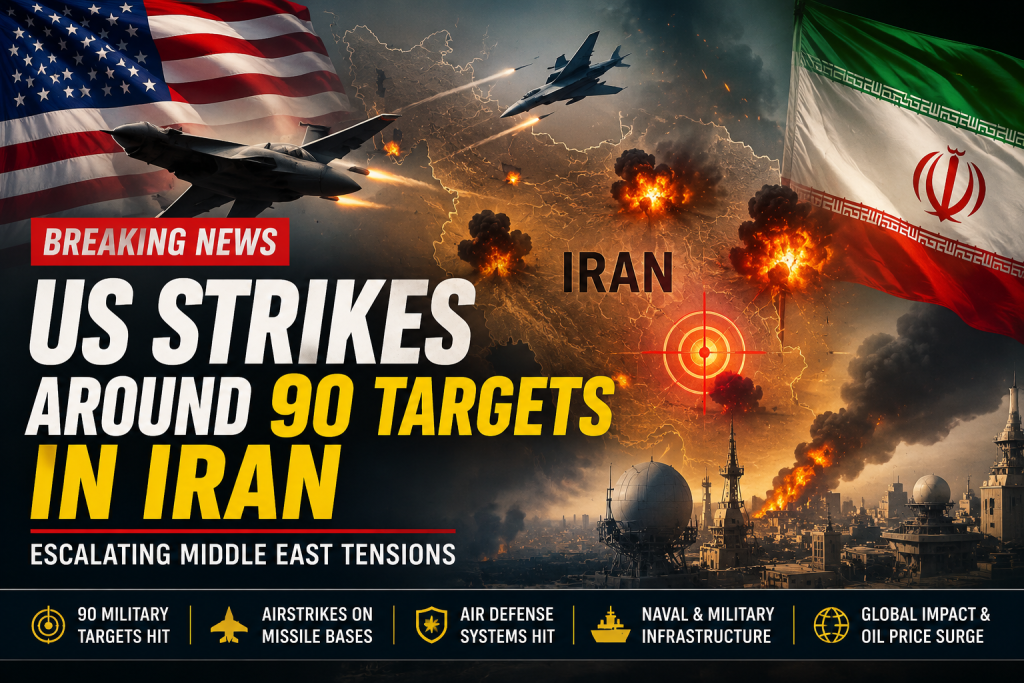
US Launches Massive Airstrikes on 90 Military Targets Across Iran
The United States launched airstrikes on approximately 90 military targets across Iran, marking one of the largest operations in recent months. Read the latest developments, international reactions, and the potential global impact.
The United States has carried out one of its most extensive military operations against Iran in recent months, launching coordinated airstrikes on approximately 90 military targets across multiple regions of the country. The operation marks a significant escalation in the ongoing confrontation between Washington and Tehran and has heightened fears of a broader conflict across the Middle East.
According to U.S. military officials, the strikes were aimed exclusively at military infrastructure believed to be linked to missile operations, naval capabilities, command centers, air defense systems, and logistics facilities. The Pentagon stated that the objective was to reduce Iran’s ability to threaten international shipping routes and regional security while avoiding civilian infrastructure wherever possible.
The latest military action follows a sharp increase in tensions after several commercial vessels operating near the Strait of Hormuz reportedly came under attack. U.S. officials accused Iranian-backed forces of threatening maritime security and disrupting one of the world’s most important energy corridors.
The Strait of Hormuz remains a vital shipping route through which a substantial share of global oil exports passes each day. Any disruption in the region has immediate consequences for international energy markets and global trade. American defense officials stated that intelligence assessments indicated an increased risk of further attacks, prompting what they described as a defensive military response designed to degrade Iranian military capabilities.
Military officials said the operation involved precision-guided weapons launched from multiple platforms. Missile launch facilities Air-defense radar systems Military command-and-control centers Military command-and-control centers Naval infrastructure Logistics and weapons storage sites Communication facilities supporting military operations Officials emphasized that the strikes focused on military objectives rather than civilian population centers.
Iran strongly condemned the attacks, describing them as violations of its sovereignty. Iranian authorities reported casualties and infrastructure damage while announcing retaliatory missile and drone operations aimed at U.S. military facilities and allied positions in the Gulf region. Several Gulf countries activated air-defense systems after missiles and drones were reportedly launched toward regional military installations. Security measures were also increased around strategic energy infrastructure and transportation hubs.
Governments around the world have urged both Washington and Tehran to avoid further escalation. The United Nations and several regional governments continue diplomatic efforts to prevent the conflict from expanding into a wider regional war. International observers warn that prolonged military exchanges could threaten commercial shipping, global energy supplies, and regional stability. Many analysts believe diplomatic negotiations remain essential despite the rapidly deteriorating security environment.
Financial markets reacted quickly following reports of the strikes Oil prices experienced increased volatility as investors monitored developments around the Strait of Hormuz. Shipping companies are also evaluating security risks, while insurance costs for vessels operating in the region could rise if hostilities continue. Global crude oil prices International shipping costs Supply chains Inflation in energy-importing countries Financial market confidence
The Strait of Hormuz remains one of the world’s most strategically significant waterways. Any disruption to maritime traffic can have immediate consequences for global energy supplies. Military analysts suggest that protecting commercial navigation has become a central objective for several countries with naval forces operating in the Gulf region. Continued instability could increase the military presence of multiple international powers.
Security experts caution that the coming days will be critical in determining whether both sides choose further military escalation or renewed diplomatic engagement. Additional military operations Expanded regional security measures Emergency diplomatic negotiations Increased naval deployments Further economic market volatility While both sides continue to exchange warnings, international mediators are working to reduce tensions before the conflict expands further.