Middle East Crisis Deepens After US Military Strikes on Iran
Washington and Tehran Exchange Military Action Amid Renewed Crisis
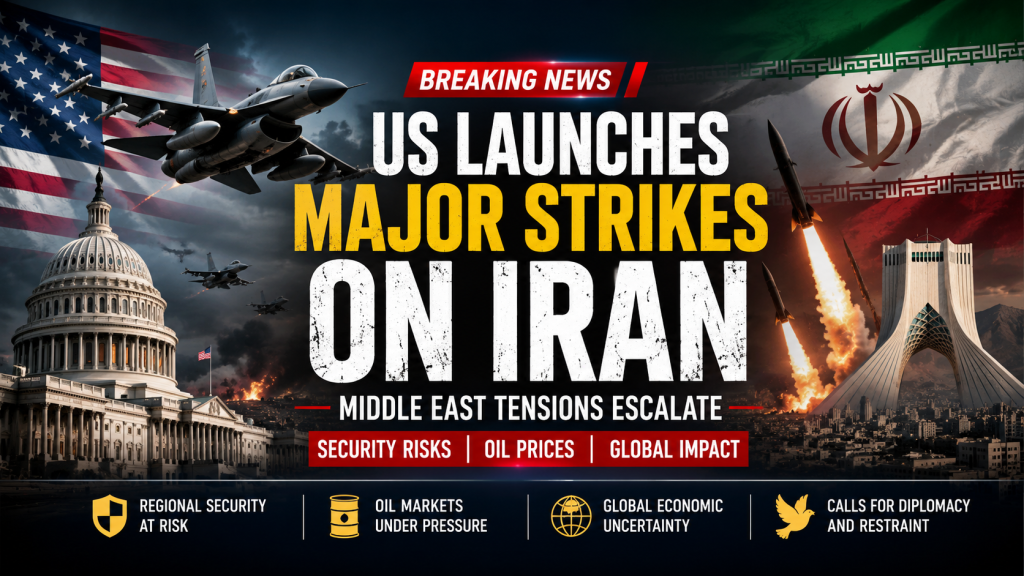
The United States has launched a new wave of military strikes against Iranian targets, marking one of the most significant escalations in the ongoing confrontation between Washington and Tehran in recent months. The operation, announced by U.S. Central Command, targeted more than 80 military sites across southern Iran, including air-defense systems, command facilities, coastal radar installations, anti-ship missile infrastructure, and Revolutionary Guard naval assets operating near the strategically vital Strait of Hormuz.
The strikes followed a series of attacks on commercial shipping routes in the Gulf region, which U.S. officials blamed on Iranian forces. Washington described the military action as a defensive measure intended to protect international maritime trade and maintain freedom of navigation through one of the world’s most important energy corridors.
Iran responded by launching missiles and drones toward U.S. military installations in Bahrain and Kuwait, accusing Washington of violating previous diplomatic understandings and escalating regional instability. Iranian military officials vowed that the country would continue defending its sovereignty against what they described as foreign aggression. Regional governments have increased security around key military and civilian infrastructure as fears of further retaliation continue to grow.
The Strait of Hormuz remains one of the world’s most strategically important waterways, carrying a significant share of global crude oil exports every day. Any military activity in the region immediately attracts worldwide attention because of its potential impact on global energy supplies.
According to U.S. officials, several of the targeted Iranian military facilities were linked to operations capable of threatening commercial vessels passing through the Strait. The objective of the strikes, they said, was to reduce Iran’s ability to disrupt international shipping and regional maritime security. Shipping companies and insurers are closely monitoring developments, while several maritime operators have reviewed security procedures for vessels traveling through the Gulf.
The renewed military confrontation has also dealt a significant blow to diplomatic efforts aimed at easing tensions between the two countries. President Donald Trump stated that previous understandings with Iran were effectively finished following the latest attacks, casting doubt on the future of ongoing negotiations. Although U.S. officials have indicated that diplomatic channels remain technically open, prospects for immediate dialogue appear increasingly uncertain
International observers warn that without renewed diplomatic engagement, the risk of additional military escalation could increase significantly. Financial markets responded immediately to the latest developments.
Oil prices climbed as investors priced in the possibility of supply disruptions from the Middle East. Energy analysts noted that any prolonged conflict affecting the Strait of Hormuz could influence global fuel prices, transportation costs, and inflation in multiple economies. Stock markets also experienced increased volatility as investors shifted toward safer assets amid growing geopolitical uncertainty.
Several governments and international organizations have urged both Washington and Tehran to avoid further escalation. Diplomatic leaders emphasized the importance of protecting civilian lives, maintaining international shipping routes, and preventing the conflict from expanding across the wider Middle East. Analysts believe that neighboring Gulf countries could face increased security risks if hostilities continue.
The situation has also renewed discussions within international forums regarding maritime security, regional defense cooperation, and the importance of diplomatic conflict resolution.
Economists caution that a prolonged confrontation could have consequences extending far beyond the Middle East. Higher global energy prices. Increased shipping insurance costs. Supply chain disruptions. Financial market volatility. Rising transportation expenses. Pressure on inflation worldwide. Many countries remain heavily dependent on stable energy exports from the Gulf region, making continued stability in the Strait of Hormuz essential for the global economy.
Military analysts suggest that the coming days will be critical. If both sides continue retaliatory actions, the conflict could expand further across the region. However, diplomatic mediation by international partners may still provide opportunities to reduce tensions before a broader regional crisis develops. Governments, businesses, and energy markets will continue monitoring developments closely as military operations, diplomatic negotiations, and international responses evolve.
For now, the latest exchange of strikes underscores how quickly geopolitical tensions can affect global security, international trade, and economic stability. While military activity has intensified, many world leaders continue urging restraint and renewed diplomatic engagement to prevent a wider conflict that could have lasting international consequences.