
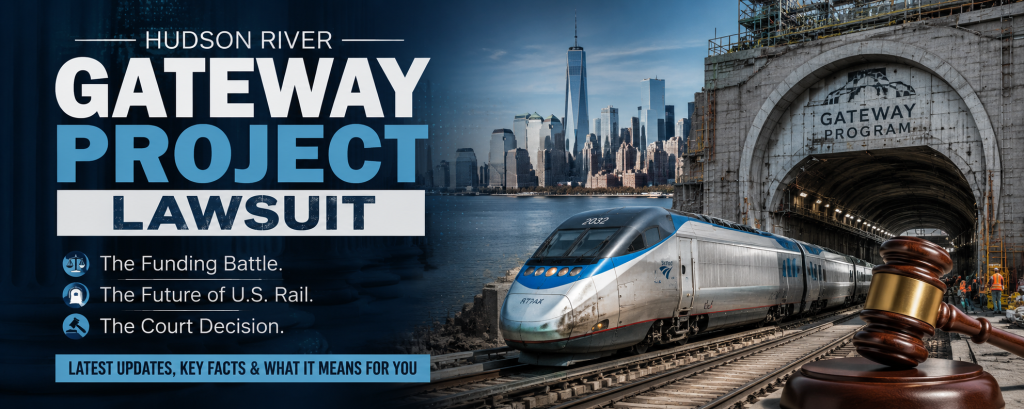
Why the Hudson River Gateway Project Lawsuit Matters for U.S. Rail Travel
A federal judge has permanently blocked efforts to freeze funding for the Hudson River Gateway Project, allowing construction of the multibillion-dollar rail tunnel connecting New York and New Jersey to continue.
The long-running legal battle surrounding the Hudson River Gateway Project reached a significant milestone after a federal judge permanently blocked the suspension of billions of dollars in federal funding for the project. The decision ensures that construction of one of the most important transportation infrastructure projects in the United States will continue without further interruption.
The Gateway Program has long been considered essential to improving rail transportation between New York and New Jersey. With aging infrastructure, increasing passenger demand, and decades of delayed investment, transportation officials have repeatedly warned that modernizing the Northeast Corridor is critical for the nation’s economy. The court’s ruling provides renewed certainty for contractors, workers, commuters, and state governments that have invested heavily in the project.
The Gateway Program is a large-scale transportation initiative designed to modernize rail infrastructure along the Northeast Corridor—the busiest passenger rail route in the United States. Its centerpiece is the Hudson Tunnel Project, which will construct a new two-track rail tunnel beneath the Hudson River while allowing the existing tunnel, originally opened in 1910, to undergo extensive rehabilitation.
The current tunnel remains one of the nation’s busiest rail links, serving approximately 200,000 passenger trips every weekday. Years of heavy use and damage caused by Hurricane Sandy in 2012 have raised growing concerns about its long-term reliability. Transportation experts believe the new tunnel will dramatically improve service reliability, reduce delays, and strengthen one of America’s most economically important transportation corridors.
The lawsuit began after the federal government temporarily suspended billions of dollars in grants and loans that had already been committed to the Gateway Project. Federal officials stated they wanted to review the project before releasing additional funding. However, New York and New Jersey argued that the funding freeze violated existing agreements and federal law.
The two states, along with the Gateway Development Commission, filed lawsuits seeking immediate restoration of the money, arguing that construction delays would result in enormous financial losses, project disruptions, and thousands of potential job losses. Project officials also warned that contractors would be forced to stop work if funding was not restored quickly.
In a major legal victory for project supporters, U.S. District Judge Jeannette Vargas ruled that the federal government lacked sufficient legal authority to continue withholding the project’s funding. The court permanently barred the administration from freezing the approved financial support, concluding that the government failed to justify its actions under existing federal regulations.
The ruling follows earlier temporary court orders that had already required federal officials to continue releasing funds while the case proceeded. Legal experts say the permanent injunction provides much greater certainty for the project’s future.
With funding restored, construction activities are expected to continue across multiple sections of the Gateway Program.
- Hudson River ground stabilization
- Tunnel approach construction
- Utility relocation
- Future tunnel boring preparations
- Supporting infrastructure upgrades
Project leaders have emphasized that maintaining uninterrupted construction is essential for keeping the multibillion-dollar project on schedule. Industry analysts estimate that prolonged delays could have added hundreds of millions of dollars in additional construction costs.
Transportation planners describe the Gateway Program as one of America’s most important infrastructure investments.
- Increased rail capacity between New York and New Jersey
- Improved commuter reliability
- Reduced train delays
- Greater resilience against future infrastructure failures
- Stronger economic connectivity throughout the Northeast Corridor
The new tunnel will also allow the century-old existing tunnel to undergo comprehensive repairs without completely disrupting rail service.
The Gateway Project represents a major source of employment and economic activity. Thousands of construction workers, engineers, contractors, suppliers, and transportation specialists are directly involved in the project. State officials argued throughout the lawsuit that any extended funding freeze would threaten thousands of jobs while delaying critical infrastructure improvements relied upon by millions of travelers each year.
Although the court has resolved the primary dispute over federal funding, some related legal issues involving contractual claims and financial damages may continue in separate proceedings. For now, however, the court’s decision removes one of the largest obstacles facing the Gateway Program and allows work to proceed toward its long-term completion.
Transportation agencies remain focused on delivering the new Hudson River tunnel, which is expected to become one of the most significant rail infrastructure improvements completed in the United States in decades.