
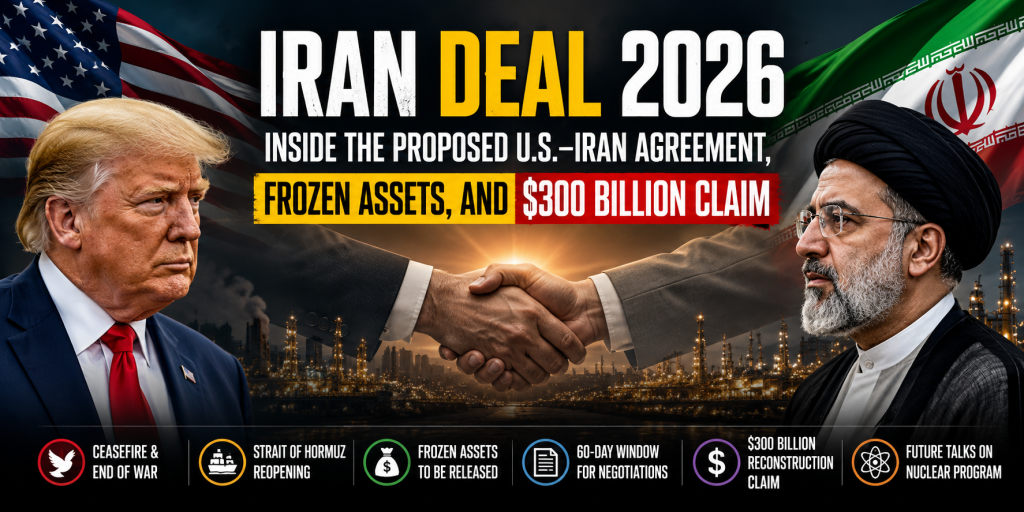
Iran Deal 2026: Inside the Proposed U.S.–Iran Agreement, Frozen Assets, and $300 Billion Claim
The proposed U.S.–Iran agreement could reshape the Middle East. Learn about sanctions relief, frozen assets, nuclear commitments, the Strait of Hormuz reopening, and the controversial $300 billion claim. A major diplomatic breakthrough may be unfolding in the Middle East as the United States and Iran move closer to a proposed peace and normalization agreement that could reshape regional politics, global energy markets, and international security.
Recent reports from multiple international news organizations indicate that Washington and Tehran have reached a preliminary framework agreement aimed at reducing tensions, reopening critical shipping routes, addressing sanctions, and restarting negotiations over Iran’s nuclear program. While the final document has not yet been formally signed, the reported memorandum of understanding (MoU) represents the most significant diplomatic development between the two countries in years.
Background: Why the Deal Matters
Relations between the United States and Iran have remained tense for decades, with disputes centered on sanctions, regional security, military activity, and Iran’s nuclear ambitions.
The latest negotiations emerged after months of conflict and economic disruption in the region. One of the most important consequences of the crisis was the disruption of shipping through the Strait of Hormuz, a strategic waterway through which a significant portion of the world’s oil exports pass. Any interruption in this route has immediate effects on global energy prices and economic stability.
Diplomatic mediation efforts involving Pakistan and Qatar reportedly helped both sides move toward a framework agreement intended to halt hostilities and establish a path toward broader negotiations.
Key Terms Reportedly Included in the Draft Agreement
Although officials from both countries have presented slightly different versions of the proposed agreement, several provisions appear consistently across multiple reports.
1. Reopening the Strait of Hormuz
One of the most important provisions would involve reopening the Strait of Hormuz to commercial shipping.
The reopening would help restore global energy flows, reduce supply-chain uncertainty, and ease pressure on international oil markets. Financial markets have already reacted positively to reports of progress in negotiations.
2. Sanctions Relief
The draft framework reportedly includes temporary waivers and relief from certain U.S. sanctions imposed on Iran’s economy, particularly those affecting oil exports.
Under the proposal, no additional sanctions would be imposed during the negotiation period while both sides work toward a comprehensive agreement.
3. Release of Frozen Iranian Assets
One of the most discussed aspects of the agreement involves Iranian assets frozen overseas.
Different reports cite varying figures. Some versions mention approximately $24 billion in frozen assets, while others refer to $25 billion that could be released under specific conditions tied to future negotiations and compliance measures.
4. Nuclear Commitments
According to reported terms, Iran would agree not to pursue nuclear weapons and would maintain the current status of its nuclear program while broader negotiations continue.
The framework reportedly calls for a halt to further expansion of uranium enrichment activities and additional discussions on long-term nuclear arrangements during a 60-day negotiation period.
5. Sixty-Day Negotiation Window
Rather than resolving every dispute immediately, the proposed agreement establishes a 60-day period during which negotiators would attempt to finalize a comprehensive settlement covering nuclear issues, sanctions relief, economic cooperation, and regional security concerns.
The Controversial $300 Billion Claim
Perhaps the most attention-grabbing element of recent reports is the claim that a $300 billion reconstruction or development package could be part of the broader framework.
The figure has been circulated primarily through Iranian media reports and references to draft negotiating documents. However, U.S. officials have not publicly confirmed a direct transfer of $300 billion to Iran.
Current reporting suggests that the proposal may refer to a long-term reconstruction and development framework involving international partners rather than an immediate cash payment. The exact details remain unclear and continue to be a subject of debate.
Political Challenges Ahead
Even if negotiators reach a final agreement, significant political hurdles remain. In Iran, hardline factions have criticized the proposed arrangement, arguing that it does not provide sufficient guarantees regarding sanctions relief and national sovereignty.
In the United States, lawmakers are expected to closely examine any agreement involving sanctions relief, nuclear commitments, or the release of frozen assets. Some provisions could face congressional scrutiny before implementation.
Impact on Global Oil Markets
Energy traders have closely monitored every development in the negotiations. Reports of progress between Washington and Tehran have contributed to declining oil prices because investors expect fewer disruptions to global energy supplies if the Strait of Hormuz remains open and regional tensions continue to ease.
For oil-importing nations, including India, lower energy prices could reduce inflationary pressures and support economic growth. For exporters, however, softer prices may create revenue challenges.
What Happens Next?
Officials are expected to continue discussions regarding the final language of the agreement and implementation mechanisms. A formal signing ceremony has been discussed in diplomatic reporting, although some details remain unresolved. Differences between Iranian and American descriptions of the agreement suggest that negotiations are still ongoing despite signs of substantial progress.
The proposed U.S.–Iran agreement could become one of the most significant geopolitical developments of 2026. If finalized, it may help reduce military tensions, reopen critical trade routes, ease sanctions pressure, and restart long-stalled diplomatic engagement between the two countries.
However, important questions remain unanswered, particularly regarding the reported release of frozen assets, the controversial $300 billion reconstruction claim, and the future of Iran’s nuclear program. Until a final agreement is signed and officially confirmed by both governments, many of the reported provisions should be viewed as part of an evolving diplomatic process rather than completed policy.