
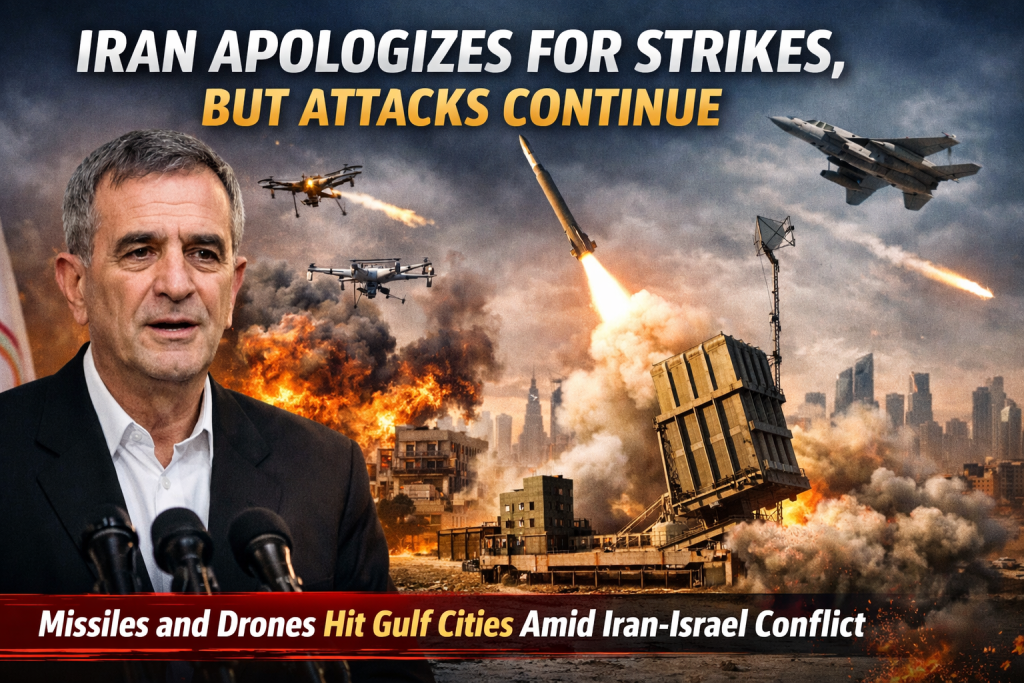
Iran’s President Apologizes for Strikes on Neighboring Countries as Missiles and Drones Continue to Hit Gulf Cities
The escalating Middle East conflict took another dramatic turn as Masoud Pezeshkian, the President of Iran, issued a public apology to neighboring countries after Iranian missiles and drones struck cities across the Gulf region. Despite the apology, attacks reportedly continued, heightening fears that the regional war could expand even further. The conflict has already drawn in several countries and global powers, including Israel, the United States, and multiple Gulf states, creating one of the most volatile geopolitical crises in recent years.
Iran’s President Issues Apology In a televised address, President Masoud Pezeshkian expressed regret over the strikes that affected neighboring nations. He emphasized that Iran did not intend to harm nearby countries and that the attacks were linked to the ongoing military conflict with Israel and Western allies. Pezeshkian stated that Iran respects its regional neighbors and would avoid targeting them unless they become directly involved in military actions against Iran. However, even as the apology was delivered, reports indicated that Iranian missiles and drones continued to
target locations across parts of the Gulf, raising questions about whether Iran’s civilian leadership fully controls the military operations underway. Missiles and Drones Target Gulf Cities Several Gulf nations reported incoming drones and missile attacks in recent days. Air defense systems were activated in multiple cities as governments attempted to intercept incoming threats. Among the countries affected were: Saudi Arabia Bahrain Kuwait United Arab Emirates Authorities in these countries reported that many of the incoming drones and missiles were intercepted, but some attacks caused damage to infrastructure and disrupted transportation and aviation operations.
Airports across the region briefly suspended flights as a precaution, and oil facilities were placed on high alert. War Between Iran and Israel Intensifies The strikes come amid an intensifying military confrontation between Iran and Israel. The conflict escalated after Israeli airstrikes targeted Iranian military facilities earlier this year. In response, Iran launched waves of ballistic missiles and drones targeting Israeli positions and facilities linked to Western forces in the region. Israeli defense systems, including the Iron Dome, have been working to intercept many of the incoming threats. However, the scale and frequency of the attacks have placed heavy pressure on regional defense networks.
U.S. Involvement Raises Global Tensions The situation has become even more complicated with the involvement of the United States, which maintains military bases across the Gulf. Former U.S. President Donald Trump, who remains deeply involved in American foreign policy discussions, recently warned Iran that it must agree to strict conditions to end the conflict. U.S. military forces in the region have increased defensive operations, and additional naval and air assets have reportedly been deployed to protect allies and maintain security in critical shipping lanes. The presence of U.S. forces has raised fears that the conflict could escalate into a broader international confrontation.
Oil Markets and Global Economy Impacted The conflict has already had a significant impact on global markets. Oil prices surged as investors feared potential disruptions to supply from the Gulf region, which produces a large portion of the world’s crude oil. Major shipping routes in the Persian Gulf and the Strait of Hormuz have also come under heightened security, as any disruption in these areas could severely affect global trade. Air travel across the Middle East has faced delays and rerouting as airlines attempt to avoid conflict zones.
Concerns About Military Control Inside Iran Analysts believe the continuation of strikes despite the president’s apology may reflect internal divisions within Iran’s political and military leadership. Much of Iran’s missile and drone capability is controlled by the Islamic Revolutionary Guard Corps (IRGC), a powerful military organization that operates with significant independence. Some experts believe that operational decisions during the conflict may be driven more by military command structures than by civilian leadership.
Growing Fear of Regional War With missiles continuing to fly and air defenses active across multiple countries, the risk of a broader Middle East war remains high. International organizations and diplomatic leaders have called for restraint and renewed negotiations to prevent the crisis from spiraling further out of control. The United Nations has urged all parties involved to avoid targeting civilian areas and to seek diplomatic solutions before the conflict expands into a full-scale regional war.
For now, the Middle East remains on edge. While Iran’s president has apologized for strikes affecting neighboring countries, the continued drone and missile attacks suggest that the situation remains unstable and unpredictable. Diplomatic efforts are ongoing, but with multiple countries involved and military operations still underway, the path toward de-escalation remains uncertain. The coming days will likely determine whether the region moves toward peace negotiations or faces an even larger and more dangerous conflict.