
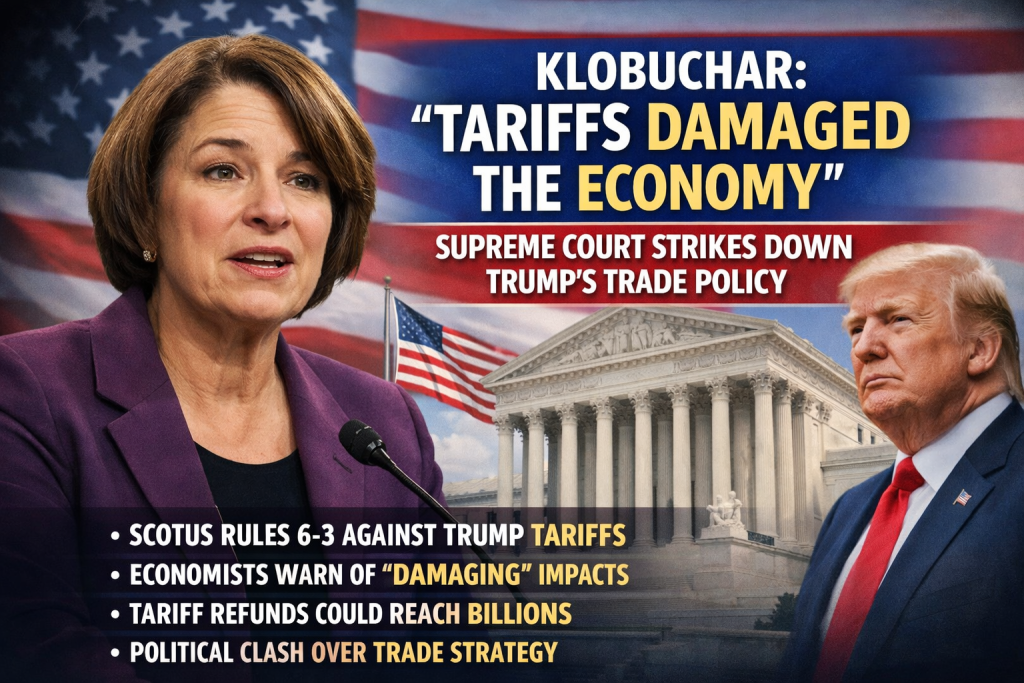
Amy Klobuchar Says Tariffs ‘Damaged’ the Economy After Supreme Court Strikes Down Trump Policy
In a major political and economic development, U.S. Senator Amy Klobuchar said former President Donald Trump’s tariff policies “damaged” the American economy after the Supreme Court of the United States ruled against a key part of Trump’s trade agenda. The decision marks a turning point in the long-running debate over presidential authority, trade wars, and the economic impact of tariffs on American businesses and consumers.
Supreme Court Ruling: What Happened In a 6–3 decision, the Supreme Court ruled that Trump exceeded his authority when imposing broad global tariffs under the International Emergency Economic Powers Act (IEEPA). The Court stated that the U.S. Constitution grants Congress—not the president—the power to impose taxes and tariffs. The ruling effectively invalidates sweeping tariff measures that had been central to Trump’s economic strategy, especially during trade disputes with China and other major economies.
Legal experts say the decision reinforces the separation of powers and limits the executive branch’s ability to unilaterally reshape trade policy without congressional approval. Amy Klobuchar’s Reaction Increased costs for American families Hurt small businesses Created uncertainty in global markets Damaged farmers and manufacturers She argued that tariffs functioned as a “hidden tax” on consumers, raising prices on everyday goods ranging from electronics to household products.
Klobuchar emphasized that economic policy should focus on strengthening supply chains, supporting American workers, and promoting fair trade without unnecessarily burdening consumers. How Tariffs Impacted the EconomyTrump’s tariff strategy aimed to pressure trading partners, particularly China, to renegotiate trade agreements. While supporters argued it protected American industries, critics pointed to several economic consequences:
How Tariffs Impacted the Economy Trump’s tariff strategy aimed to pressure trading partners, particularly China, to renegotiate trade agreements. While supporters argued it protected American industries, critics pointed to several economic consequences Higher Consumer Prices Import tariffs increased the cost of foreign goods, which often translated into higher retail prices for U.S. consumers. Supply Chain Disruptions Manufacturers relying on imported components faced increased costs and logistical challenges.
Farmer Retaliation Impact U.S. farmers were hit by retaliatory tariffs from other countries, reducing export opportunities Business Uncertainty Ongoing trade disputes created volatility in financial markets and investment planning Could Refunds Be Coming One of the biggest questions following the ruling is whether businesses could receive refunds for previously collected tariffs. Analysts suggest the potential total could reach tens or even hundreds of billions of dollars, though legal and administrative processes could take years
Political Implications Democrats view it as a victory for constitutional limits and consumer protection Republicans and Trump allies argue the decision weakens America’s ability to respond aggressively to unfair trade practices. Trump’s supporters maintain that tariffs were necessary leverage in negotiations and helped secure revised trade agreements The ruling does not eliminate all tariffs but limits how broadly a president can impose them under emergency authority. Congress may now face increased pressure to clarify or expand trade legislation
Meanwhile, markets and global trade partners are closely watching how the United States reshapes its trade strategy moving forward Senator Amy Klobuchar’s remarks reflect broader Democratic criticism that Trump’s tariffs harmed consumers and businesses. With the Supreme Court striking down key aspects of the policy, the debate over trade, executive power, and economic growth enters a new phase. The ruling not only reshapes U.S. trade policy but also reinforces constitutional boundaries—ensuring that .