






NASA’s Artemis II mission marks a historic step in humanity’s return to the Moon. As the first crewed mission under the Artemis program, Artemis II will carry astronauts around the Moon, paving the way for future lunar landings. At the heart of this mission is a legendary and highly advanced launch site Launch Complex 39B (LC-39B) at NASA’s Kennedy Space Center in Florida. What Is the Launch Pad for Artemis II
The NASA Artemis II mission will launch from Launch Complex 39B (LC-39B), located at Kennedy Space Center (KSC), Florida, USA. This pad has been fully modernized to support NASA’s most powerful rocket ever built, the Space Launch System (SLS). Location and Background of LC-39B Launch Site: Kennedy Space Center, Merritt Island, Florida Launch Pad: Launch Complex 39B Originally Built For: Apollo missions (including Apollo Moon landings) Later Used By: Space Shuttle program Now Used For: Artemis missions and future deep-space exploration
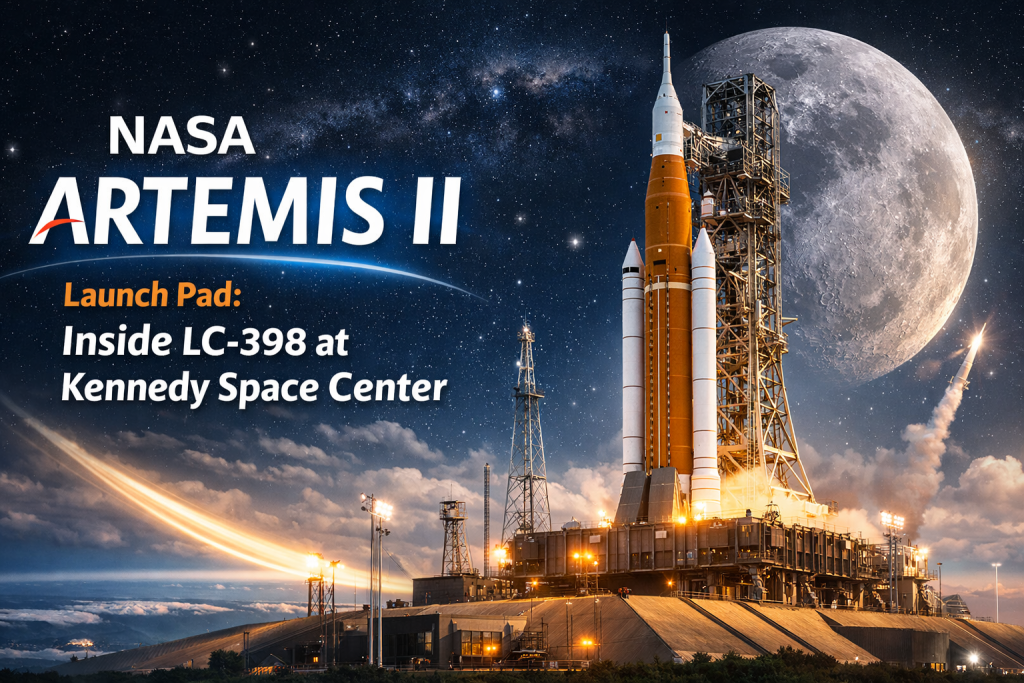
LC-39B is one of the most iconic launch pads in spaceflight history. From Apollo astronauts heading to the Moon in the 1960s to today’s Artemis program, the pad represents NASA’s long-term vision for human exploration beyond Earth. Why LC-39B Is Ideal for Artemis II NASA redesigned LC-39B using a “clean pad” concept, meaning most mission-specific hardware is located on mobile platforms instead of being permanently fixed to the pad Key advantages include Faster launch preparations Support for multiple rocket configurations Improved safety for crewed missions Flexibility for future Moon and Mars missions
Launch Vehicle: Space Launch System (SLS) Artemis II will use NASA’s Space Launch System (SLS), the most powerful rocket ever developed SLS highlights Height: Over 98 meters (322 feet) Thrust: More than 8.8 million pounds at liftoff Purpose: Carry astronauts and cargo beyond low Earth orbit The rocket will lift off from LC-39B with the Orion spacecraft, carrying four astronauts on a lunar flyby mission
Crew Access and Safety Systems LC-39B includes advanced infrastructure specifically designed for crewed launches: Crew Access Arm: Allows astronauts to enter the Orion spacecraft safely Emergency Escape System: Enables rapid evacuation in case of launch emergencies Lightning Protection Towers: Protect the rocket from Florida’s frequent storms These upgrades make LC-39B one of the safest human-rated launch pads ever built
DIGI MERCH STORE PRINT ON DEMAND

What Is the Artemis II Mission Artemis II is a 10-day mission that will send astronauts around the Moon without landing Mission goals Test life-support and propulsion systems Validate Orion spacecraft performance with crew onboard Prepare NASA for Artemis III, which will land astronauts on the Moon This mission represents the first time humans will travel beyond low Earth orbit since Apollo 17 in 1972.
Importance of LC-39B for the Future LC-39B is not just for Artemis II. It will serve as the primary launch pad for Future Artemis lunar landing missions Gateway lunar space station components Long-term Mars exploration missions NASA envisions LC-39B as the foundation for decades of human spaceflight
The NASA Artemis II launch pad, LC-39B, is a powerful symbol of past achievements and future ambitions. With state-of-the-art technology, historic legacy, and unmatched capability, LC-39B will once again send humans on a journey toward the Moon — and eventually Mars As Artemis II prepares for launch, the world will be watching as NASA ignites a new era of human exploration from this legendary pad
NASAspacelaunch GraphicReports
Humanspaceflight Instagramposts
Comment